
What's the difference between Abbott Elementary and The Pitt?
We educators just don’t learn from each other in quite the same way.

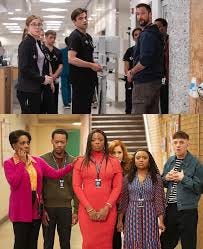
First, let’s start with what they have in common:
They both take place in Pennsylvania and portray hard-working, righteous service workers who commit their lives to the common good. PA Golden-child Benjamin Franklin would be proud of all these hospital workers and educators and their commitment to “the common good of the community.” Public Hospitals and Public Schools have that going for them - they are bedrocks of our society, and offer the best of the American spirit.
We should all be grateful to the workers who perform these roles in real life!
In both shows, we see workers doing their best in less-than-ideal circumstances, gripped by bureaucracy, dysfunction, and administrators who are, in the case of Abbott, comically incompetent, or in the case of The Pitt, focused on the wrong things. Both should ring alarm bells about the state of our public institutions, but this short stack here is not a battle cry in that regard, but to point out the obvious.
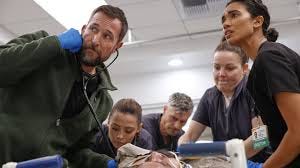
In the Pitt, the workers work together. Iron sharpens iron in nearly every scene. Doctors, nurses, residents, interns…all crowd around patients and pool knowledge and opinions to make decisions. It’s the nature of an ER, and it’s the way doctors are trained. We see frequent quizzing, recitations of facts, residents jockeying to prove their worth and skill, and doctors constantly questioning each other and testing theories in real time.
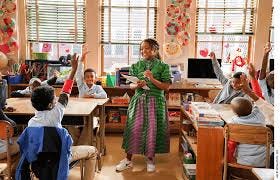
In Abbott Elementary, when the teachers are together, they are not doing the business of teaching. We see them in the hallway, in the teacher’s lounge, in common spaces like the cafeteria, and of course, out of school. But rarely do we see them in the same classroom, watching each other hone their craft. In the classroom, they are alone. And it’s not simply because it’s not funny and ill-fitting of the genre - it’s not happening in the show, because it rarely happens in real life.
WHAT A MISSED OPPORTUNITY!
We, as a profession, need to SEE each other in action. We need to recognize that we are limiting ourselves, and that our students are missing out. If the only templates we have for “how to be a teacher” come from a) the teachers we had while we were students, b) the teachers we were exposed to in our early years as a student teacher, and c) our own personal teaching style, then we are severely limiting range of skill and opportunity we can be offering our students. We are growing slower than we need to be. We must find ways to routinize teacher visitations and healthy co-teaching environments where continuous improvement and peer-to-peer feedback are normalized. There is SO MUCH to be learned from visiting other classrooms and other schools!
A few ways forward…
Learning Walks: This year I’ve had the privilege of partnering with Rome City School District in NY leading approximately 25 teachers through learning walks across all eight of the district’s schools. We spend between 7-15 minutes in rooms and exclusively look for “bright spots.” We define those as instructional moves teachers want to compliment their peers on, or “steal” to take back to their own classrooms. Over the course of this year we’ve collectively visited approximately 75 classrooms - building trust, gaining perspective, and inching our way towards a more transparent and supportive professional environment.
Video: I discussed this in a previous Substack, and maintain that one of the best/easiest ways to see each other is through video. I would urge every teacher to find a teacher friend to do a video exchange with before the end of this year. Start by keeping it simple: “What works about this five-minute introduction to adding fractions?” As you get more comfortable, or if you are already there, ask pointed questions, “In this five-minute intro about adding fractions, where am I clear and where can I be clearer? How might kids be confused?” Leaders, think about how you can promote this level of peer to peer sharing!
Co-Teaching: If teachers fortunate to be in a co-teaching environment, how do they fully take advantage of that dynamic to sharpen their own skills? On the one hand, they have a front row seat to another teacher’s approach. That’s terrific. And - this is where I think we as a profession can go deeper - you have an adult watching you. How teachers leverage their duo-ness is critical: Do they offer one another feedback? Have they learned to have professional disagreements? Or do they keep quiet in the name of “preserving the relationship” because the profession as a whole hasn’t evolved to this?
Circle Up! Questions for reflection & discussion:
How do teachers learn from one another at your school?
In what ways do you create conditions for peer-to-peer collaboration?
Can you identify obstacles?
How can we launch / deepen learning walks in our school (See this great video from Edutopia describing the practice)
What practices do you have in place that you’d like to share with your educator colleagues? Please share in the comments!